Friday, April 23, 2021

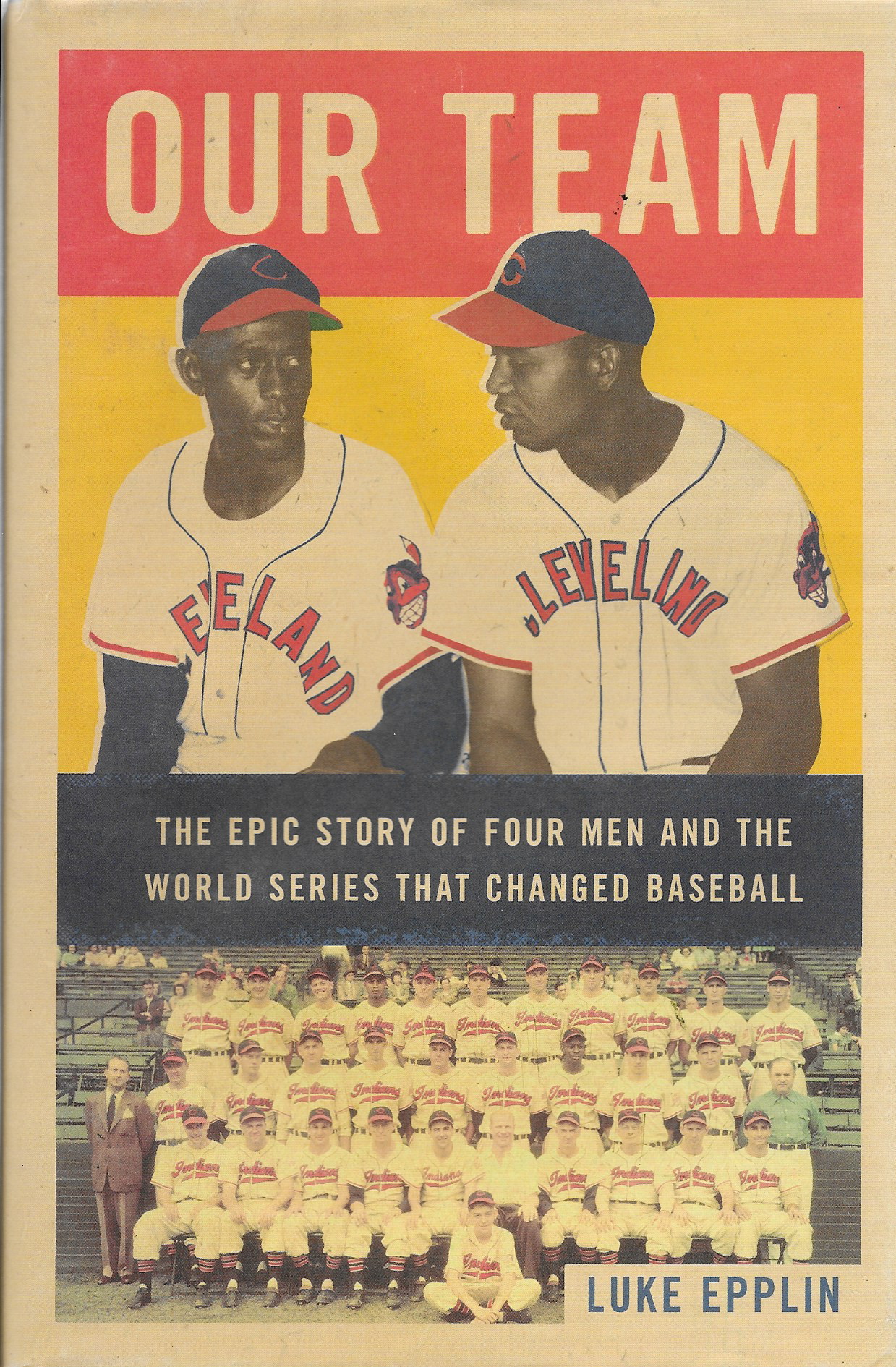
Review: Our Team (2021)

By Luke Epplin

It takes some imagination to picture the scene. Think about four men, who couldn't be more different, racing toward a mutual destiny. 

That's part of the charm of "Our Team," a look at a baseball team from the past.

We have Satchel Paige, who grew up in Mobile, Alabama, and went on to become one of the most legendary pitchers in baseball history. Speaking of pitchers, Bob Feller was from a farm in Van Meter, Iowa, where he became the most fabled young pitcher in history. Over in Paterson, New Jersey, was Larry Doby, a talented young athlete who was just figuring out how good he was. Finally we had Bill Veeck, the son of a baseball executive who never met a conventional approach he couldn't shatter. 

They were all on their way to, of all places, Cleveland. They came together when it mattered for an astonishingly brief time in hindsight - basically only in 1948. However, the foursome helped produce the only World Series championship by the Indians in the past 100 years. 

Their stories essentially make up Luke Epplin's story. As you might have guess, the key angle to most of this was the fact that baseball was on the verge of becoming integrated. Jackie Robinson first played in the Dodgers' organization in 1946 and arrived in Brooklyn in 1947. The Dodgers signed other black players, but most other teams didn't rush out to acquire talent from the Negro Leagues to keep up. A second team was needed to keep the momentum going.

Veeck was ready to be that team. He had operated a minor-league team in Milwaukee, where he developed his promotional skills. Veeck tried to purchase the Philadelphia Phillies, and stories circulated that he wanted to stock that usually dismal team with many black stars who could put an instant winner on the field. Naturally, the National League owners voted down Veeck's bid. But the colorful figure found another team to buy when the Indians came up for sale in 1946.  

When he arrived, Feller was already there. He might have been the best young pitcher in history, and he was a star almost from the day he made his debut at age 17. Feller's career was interrupted by World War II, preventing him from piling up statistics that would rank with the best ever in many categories. The interruption in the war also gave Feller extra incentive to make money when he could, and he often took postseason barnstorming trips to do so. Feller was one of the big attractions, but the other was Paige - the biggest drawing card in black baseball. Satchel was good and he knew he was good, and the word was out that he'd need to take a pay cut to play in the majors.

In 1947, Veeck decided to sign Doby, who was 23 years old and had shown potential even though baseball was only one of his best sports. Larry debuted in July of that year, a few months after Robinson's beginning in the majors, but struggled a bit as he got used to the strange surroundings of a formerly all-white world that wasn't quite sure how to deal with integration. Even Veeck thought he should have given Doby more adjustment time before putting him on the Big Stage. Still, Doby was ready to break out in 1948, hitting .301. 

The Indians became a contender in '48, but they were a little short in the pitching department. Veeck thought Paige could help on the mound - and if you could sell some tickets along the way, well, that wouldn't hurt either. Satchel did both. They were contributors to Cleveland's drive to the title that year, although they weren't the main reasons behind the surge. Feller wasn't up to his old standards either. But they all celebrated the title together, and integration took another step forward.

Epplin put in a ton of work researching this book, and it shows. The new information adds perspective in some areas, particularly about Feller's financial zest and circumstances surrounding the integration of the Indians (particularly from teammates). Books have been written by or about all four of the central characters in this story. It's really easy to fall in love with people like Veeck and Paige, who really are larger than life. Thus, some baseball fans already know plenty about the lives of those two. Feller comes off as a little bit less than warm here, while Doby certainly is the proverbial stranger in a strange land. 

Epplin doesn't go deeply into what happened to all of them once 1948 was over, but it is surprising how quickly the situation changed. Veeck had to sell the team because of a divorce. Paige's skills had started to diminish late in the 1948 season, and he was gone from that city in 1949 at the age of 42. Feller wasn't quite as overpowering as he used to be, but hung on into the mid-1950s. Doby became a terrific player in the first part of the 1950s and was later inducted into the Baseball Hall of Fame. 

This all goes by pretty quickly, which is a good comment about Epplin's approach and writing ability. I'm not sure anything could have been done any better. Those looking for a well-done first look at this memorable gathering of baseball personalities will find that "Our Team" will work nicely for them.

Five stars

Learn more about this book from Amazon.com.

Be notified of new posts on this site via Twitter @WDX2BB.

Sunday, April 18, 2021

Review: Tall Men, Short Shorts (2021)

By Leigh Montville

Leigh Montville was a member of the "Dream Team" even before the term was used in association with basketball. 

Montville was part of the sports department at the Boston Globe in the 1960s. It was a group that influenced journalism greatly in that era, and its members went on to fill time and space for newspapers, magazines, books, radio and television. You've no doubt heard of Peter Gammons, Bob Ryan, and the late Will McDonough if you are reading this. 

The rest of the staff was quite good too. They all seemed to know everything that was going on in their respective sports, essentially reinventing the "notes column" that dated back to Grantland Rice. You can't turn on a television broadcast of a national sports event without hearing from one of those "insiders."

Montville was part of that group. While he became a columnist within a relatively short period of time, Leigh was a general assignment reporter before that within the sports department. That meant if there was a game to be covered somewhere, off he went. The Globe had a morning and evening edition then, filled with different stories, and it covered almost everything, so there was always something to do.

The 1969 NBA Finals, though, certainly was a breakthrough moment for Montville. He covered those games in one of the biggest continuing assignments of his career through that point. As has been said, you never forget your first time. Montville's memories of the series, the reporting business, and his role in all of it go into his memoir, "Tall Me, Short Shorts." And in a way, it's downright charming to go along with always interesting.

The point of interest for most will center on the games themselves. This was one of those epic confrontations, with enough fascinating angles to keep anyone fascinated. Start with the Boston Celtics, who had rallied from a mediocre (for them) regular season to advance to the Finals without the home-court advantage. It was a team that had won 10 of the previous 12 titles, and it still had Bill Russell - the greatest winner in pro sports history - on the roster. It certainly felt like the end of an era, but how and when would it end?

Even so, the Los Angeles Lakers might have been the better story at that moment in time. The Lakers had two superstars in Elgin Baylor and Jerry West, but always came up as the bridesmaids. It got to the point where West never set foot in Boston unless he was playing there - too many bad memories. What did Los Angeles do to change that? The Lakers traded for Wilt Chamberlain, the greatest offensive force in basketball history. Those three almost could make the Nets' current trio of Kyrie Irving, Kevin Durant and James Harden look like benchwarmers.  

That's a great start, but there was more to it. The two cities were quite different - books vs. glitz in shorthand. The arenas were different - rat-filled and cramped vs. new and spacious. The teams' reputations were different - team-oriented vs. star-oriented. The hometown announcers (Johnny Most and Chick Hearn) sounded different - gravelly vs. smooth. Could you ask for anything more?

OK, you could ask for some drama along the way. The home-court advantage held up through the first six games, and Game Seven was in Los Angeles. That was different in previous years, when the ghosts of Boston Garden seem to spook the Lakers at key times. West was magnificent, but he hurt his leg in Game Five and wouldn't be at full strength the rest of the way.  

The storybook finish would have to wait for the Lakers, who lost Game Seven by two points. Call it a dream deferred until 1972, when West and Baylor would finally earn a championship ring. Russell and Sam Jones (another Hall of Famer) retired after that last title with bragging rights forever placed in their pockets. 

It's all quite a story, although it might not have received the historical treatment that it should. The New York Knicks fulfilled their potential by winning it all in 1970 - beating the Lakers, of course. That Knicks' team was a great one, and it captured the imagination of all of New York. It became a turning point in the NBA's history, as the media outlets crowded around the Knicks to tell that tale. Therefore, a retrospective of the Celtics-Lakers series the year before is a fine idea. 

Montville uses as many tools as he could fine to tell the story. He digs up the original stories that he wrote during the matchup as well as ones composed by others. Montville talked to some of the players involved, and found recordings of some of the games. 

Mostly, though, the reporter calls on his memory bank to supply information. He has plenty of stories about how he did the work during those two weeks in the spring of 1969. Montville also comes up with stories about what he was thinking at the time, and how those first impressions have changed over the years as he reflects on them now. 

That's a lot to digest, but there is one other point worth mentioning here. The rest of the "Dream Team" members at the Globe were information-oriented. They knew stuff that no one else did, and were thrilled to see it printed. But 1969 was a time when the so-called "New Journalism" was popular, and Montville practiced it. He was more interested in telling a story through anecdotes than through facts - preferably with a little style. This made him stand out a bit in the crowd when reading the newspaper. 

But Montville's writing style can be a little quirky. He often refers to himself through the book as The Bright Young Man, or TBYM - the reporter who in hindsight didn't know as much as he thought he did, but was still soaking up techniques as quickly as he can. I can almost guarantee that some people will find this way of writing the story delightful and others will find it annoying. That's been the reaction to his other books, including ones on Manute Bol, Muhammad Ali, Babe Ruth and Ted Williams. I don't expect anything different here. 

"Tall Men, Short Shorts," then, might not work for everyone as well as it did for me. I'm certainly in the target audience for this book - a sports writer who rooted for the Celtics when he was 13 during this series. Even so, there's enough material about a key moment in basketball history to keep most people well entertained.

Four stars

Learn more about this book from Amazon.com.

Be notified of new posts on this site via Twitter @WDX2BB.

Friday, April 2, 2021

Review: Forty Years a Giant (2021)

By Steven Treder

The photo on the cover of "Forty Years a Giant" is telling. Horace Stoneham is sitting in the front row of a baseball stadium,, with patriots bunting covering on the railing It's obviously a big day for the owner of baseball's Giants, if only based on the decoration. Maybe it's the World Series, or maybe it's Opening Day. But he's about to watch his team play, and that meant it was going to be a good day.

Stoneham indeed owned the Giants for 40 years, taking over from his father. Charles Stoneham was a slightly shady businessman in New York City, but none of the slight-of-hand passed on to Horace. The Giants became his life's work for 40 years, and he loved virtually minute until financial issues forced him to sell in 1976.

That's quite a run, and he certainly played a good-sized role in baseball history. Therefore, Stoneham certainly is a good choice for a full biography. Author Steven Treder delivers one with this good-sized (more than 400 pages) of text.

Horace always will be associated with something that happened about in the middle of his tenure. By the mid-1950s, it was obvious that the Polo Grounds, the Giants' home in New York City for decades, was no longer a good place for a baseball team. Fans were staying away in droves, in spite of the fact that emerging superstar Willie Mays was on the roster. What's more, the Brooklyn Dodgers were having similar issues just down the proverbial street. Stoneham and Dodgers owner Walter O'Malley came up with a plan.

The two men decided that moving both franchises was the best option under the circumstances, as hopes of a new stadium were quickly buried. In order to maintain something of a rivalry, the Dodgers packed for Los Angeles while the Giants ended up in San Francisco. As it worked out, the Dodgers got the better of the deal, building a better stadium and attracted millions from a larger fan base. The Giants didn't even get the benefit of nostalgia; the Dodgers' move seemed to anger their fans for decades while mourning for the Giants wasn't so public.

Stoneham was essentially the owner and general manager of the Giants throughout his tenure. That was something of a throwback to the old days of baseball, when such combinations were commonplace. The franchise was usually competitive in those four decades, even if the team only won the World Series in 1954 and took the National League pennant in 1962. The team had plenty of stars, but everything never quite came together most of the time. Maybe that was luck, maybe that was a case of Stoneham not having the skills to make everything work. Certainly Stoneham's affection for alcoholic beverages may have gotten in the way of good judgment at times.

Treder has done some good work writing about baseball history. He picked a tough subject for his debut. Stoneham was not the most outgoing of men around the media. What's more, he didn't save many records from his days with the Giants. Therefore, there's not much of a paper trail to follow. Meanwhile, Stoneham died in 1990, and at this point few people who works closely with him on executive matters are alive to tell the story. 

Treder did the best he could under the circumstances. The book in some ways is a history of the Giants under Stoneham's leadership, with some additional details added at the beginning and end. Every season and many of the transactions are reviewed and judged retroactively. The author certainly hits some key points along the way, but it all feels a little distant. The text probably could have lost some pages without losing much of interest under the circumstances.

It's too bad that "Forty Years a Giant" couldn't have been written about 25 to 35 years ago. Such a book might have had more insight into the longtime leader of the Giants. Still, those who are curious about this good-sized figure in baseball history will find plenty to consider.

Three stars

Learn more about this book from Amazon.com.

Be notified of new posts on this site via Twitter @WDX2BB.