Thursday, December 8, 2022

Review: Welcome to the Circus of Baseball (2023)

By Ryan McGee

There's something inherently charming about minor league baseball. 

It represents something of a throwback to a bygone era. For more than a hundred years, young baseball players have been working their way up a ladder in the hopes of reaching a dream of playing in the major leagues. Most of them don't make it, but a few do - enough to keep the pipeline filed. 

It's also a reminder of how some of the smaller cities and towns of America used to take enormous pride in their teams, with the population pitching in to help keep the team going. Minor-league teams often were right on the margins between success and failure, and community support was essential. The ballparks usually were a little substandard, but still quaint in their own way. 

Things have changed in the last quarter-century. The minor league teams often were bought in individuals and groups who updated business practices and tried to make it more of a money-making operations. Meanwhile, the majors have taken more control of the entire operation, mandating improvements that might have been necessary but were a little heavy-handed in the process - such as reducing the number of teams. Still, baseball fans of a certain type enjoy the atmosphere; some even plan their vacations around visiting new stadiums (although the word "park" seems so much more appropriate in this context.)

Enter Ryan McGee. He currently is an ESPN writer and radio host, but he still remembers where he came from. His first job after college was as an intern with the Asheville (N.C.) Tourists in 1994. It was such a small operation that McGee worked practically in every department. You learn a lot that way, and they even paid him for it - $100 a week. No, kids, that wasn't a great deal of money back then. The occasional $50 handshake from the boss helped make ends meet.

Now he's gone back into his past and revisited those days. The resulting book is called "Welcome to the Circus of Baseball," and it's as sweet as the memory of a first love. 

When McGee arrived, the minors hadn't quite made the transition out of mom-and-pop status yet. There was about one computer in the entire business, and not many more full-time employees. The few veterans had a ton of information in their heads, such as knowing to alter concession stand item orders by the night's promotion. The three or four interns (depending on the time of year) were sort of like utility infielders. They traded roles during the course of the season, and sometimes had to be slotted into something unfamiliar during emergencies. 

There are stories along the way, of course. McGee lost a memorable battle with an ice cream machine at one point, and the resulting damage was a little less than tasty.  The rookie employee one time was part of the grounds crew, and had to haul the tarp out on the field during a storm. McGee was thrown six feet up in the air while holding the tarp, one of the risks of that particular profession.  the league's All-Star Game, some quarreling during the official photo of all the teams' mascots resulted in punches being thrown. Ouch.

The funny part for me is that a few names were thrown about during the course of the book that were familiar. Jack Lamabe was the pitching coach; he threw for the Red Sox and Cardinals, among others, in the Sixties. I had his baseball card, of course. Fred Kendall, an opposing manager in 1994, played in Elmira, N.Y., in the late Sixties when I lived there. He reportedly dated the secretary in our junior high school guidance department. We all thought that was a really good move on his part.

The Tourists' manager was Tony Torchia. Not only do I remember him as an Eastern League player in Elmira in the 1960s, but he was an Eastern League manager in the 1980s in the Red Sox system. I still remember him telling reporters a story about how some of his players one night were walking down a hotel corridor in Buffalo when a prostitute was physically thrown out of a room in front of them. Torchia said, "The players have to get used to dealing with odd things. They'll have a lot of pressure on them if them make the majors. It's a different sort of pressure here, but they still have to learn to cope with it."

If you think Torchia's words can be applied to what McGee went through in Asheville, at least in a general way, you're thinking what I'm thinking. 

McGee had to get in touch with the old gang in Asheville in order to write "Welcome to the Circus of Baseball." It sounds like he had a great time doing so, to the point where McGee probably received more enjoyment writing the book than most people will have reading it. That's more of a comment on the unexpected pleasures of "paying your dues" when you are young and relatively stupid. 

McGee still loves minor league baseball, to the point where he keeps tracks of stadiums that he's visited. If you fit into that relatively narrow demographic, you'll probably get some enjoyment out of this quick and pleasant read.

Three stars

Learn more about this book from Amazon.com. (As an Amazon affiliate, I earn money from qualified purchases.) 

Be notified of new posts on this site via Twitter @WDX2BB.

Monday, December 5, 2022

Review: The Blood and Guts (2022)

By Tyler Dunne

It's two of the best words in football: "go long."

It means that the wide receiver should take off down the field as fast as possible. Maybe, if the conditions are right, the quarterback will try to throw him a pass that results in a big gainer and/or a touchdown. 

The phrase also can be used in journalism, although the meaning is obviously different. Many writers don't get the chance to really air out a story, thanks to time and space limitations. 

And if there's one thing Tyler Dunne can do when it comes to a story - particularly one about football - it's "go long." That's coming from someone who used to edit his work at The Buffalo News for a living. When one of his stories arrived for editing, it usually was going to be something worth reading. No wonder Tyler's newsletter is called "Go Long!" He wrote the best story that I've seen on the Bills' 13-second meltdown against the Chiefs in the playoffs last season.

Take a writer like that, and naturally some sort of book is in order. Dunne has gotten around to that now, a new publication called "The Blood and Guts." It's as good as you'd expect.

Tight ends occupy a unique place in the football universe. In order to be a true success, they really have to master two separate skills. A good tight end needs to have the speed to be an effective receiver when needed. In other words, he has to be faster than an NFL linebacker. On the other hand, they have to be able to block opposing players when needed. So a tight end must be ready to bump up against defensive linemen. A sprint on one play, a collision on the next. 

Tight ends aren't particularly well paid, perhaps sometimes they can be a bit anonymous. Offensive coordinators probably would rather see the ball go to wide receivers, since that's their specialty, so the tight ends usually don't put up the big numbers. As for the blocking, well, few people have been rewarded with fame for that skill.

Luckily for Dunne, the modern tight end only came along about 60 to 65 years ago. Therefore, it's relatively easy to talk to the best in the business at the position over the years. Most of them are still with us - and available for interviews.

The list of subjects starts with Mike Ditka. He's better known now than he was during his playing days, thanks to coaching, TV work, and commercials. Let me assure you that he was a bull on cleats. It was difficult to figure out how anyone tackled the guy. Tight ends like Ditka took a lot of punishment, and their shelf life particularly in the good old days wasn't too long. But Iron Mike was a definite trailblazer.

Dunne also has chapters on John Mackey, Jackie Smith, Ozzie Newsome, Kellen Winslow, Shannon Sharpe, Ben Coates, Mark Bruener, Tony Gonzalez, Jeremy Shockey, Greg Olsen, Dallas Clark, Jimmy Graham, Rob Gronkowski, and George Kittle. That might not be the definite list of great tight ends - Bills fans might be ready to Travis Kelce of Kansas City on there at this point - but it's a great starting point.

What's more, almost of all of the guys have interesting background stories to tell. Dunne does his homework here, getting the players to open up as well talking to some of the important people in their lives. He even cleared something up for me along the way. The story making the rounds about Rob Gronkowski's transfer to a Pittsburgh-area high school usually was associated with a search for better competition. Instead, it turns out that Rob headed to Pennsylvania because his parents had just gotten divorced and he wanted to live with his father. So noted. 

If there's a drawback to the way the subject is approached, it's probably that the aspects of the game concerning contact and violence feel a bit overdone. I don't want to discount that element of the game in football's popularity growth over the years. But Tyler seems to enjoy a good hit more than I do. In the introduction he writes, "No sport captivates America like football because football is the most primitive form of competition in human existence."  I'd probably argue that boxing and ultimate fighting might have a slight edge there. It's OK; we can agree to disagree on this one. 

The players profiled in the book probably would agree with Dunne in this matter. Some came into football the hard way, and many enjoy the demands of the position. The key is that they all have a story to tell, and Dunne tells it well.

Most football fans who have more than a passing interest in the game should find "The Blood and Guts" worth their time. Let's hope there are more such attempts to "go long" in Dunne's future. 

Four stars

Learn more about this book from Amazon.com. (As an Amazon affiliate, I earn money from qualified purchases.) 

Be notified of new posts on this site via Twitter @WDX2BB.

Thursday, November 24, 2022

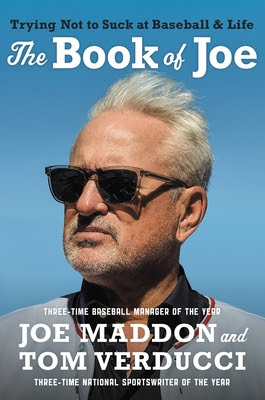
Review: The Book of Joe (2022)

By Joe Maddon and Tom Verducci

Time has a funny way of changing the perspective on a book. 

Case in point: "The Book of Joe."

We start with the names on the book. Joe Maddon certainly ranks as one of the most interesting people to be involved in the sport in the past few years. After playing briefly in the minor leagues, Maddon became something of a baseball lifer. He managed in the minor leagues and became something of a roving coach and administrator. Joe always was picking up knowledge about the game along the way. If he ever got the chance, he was going to do things his way - which was a little different from the conventional wisdom in such matters. 

Maddon took a job with the lowly Tampa Bay Rays, who never knew what it was like to win in their history. Soon, under Maddon, they won. In fact, they won often, even if their payroll was just a small fraction of the big-market teams that sometimes tend to dominate the baseball standings. No, they didn't win the World Series during Maddon's time there, but they reached it once - which was a tremendous achievement under the circumstances.

Then Maddon moved on to the Chicago Cubs as a manager, and that was a team that knew something about not winning the World Series. It had been more than a century since the Cubs won a title, but Maddon helped push them across the finish line in the fabled 2016 season. For that, Joe certainly won't have to buy an adult beverage for the rest of his life. 

That proved to be a hard act to follow, and by 2019 Maddon and the Cubs management weren't seeing eye to eye all the time. Sometimes you're only as good as last week's game. The two sides went their separate ways at the end of the season, which felt a little sad for all concerned. 

That brings us back to "The Book of Joe." He teamed up with Tom Verducci, the baseball writer for Sports Illustrated who is about as good as it gets in that business. Verducci had written a fine book on the end of the Cubs' curse after the 2016 season. Having the two of them work together is a pretty good start to a baseball book, and the finished product works out reasonably well. There is a catch in all of this, but we'll get to that in a minute. 

We go through a variety of areas for discussion here in no particularly order. For starters, it's not a typical autobiography. Yes, Maddon goes over his life in baseball - but it's more of a review of some of the lessons he learned than anything else. It's a good chance for him to credit some of the mentors and role models that he had along the way. As you might expect, that leads into some discussions about leadership techniques. While that's sometimes a tough subject for Joe and Jill Fan to understand, Maddon at least is willing to explain what went into his personal techniques in that area.

Other areas are covered too. There are some fascinating facts about the game itself. For example, at one point, Joe goes over some of the little "tells" about some the great Yankee teams in the late 1990s - how manager Joe Torre made a certain gesture when he wanted a play run, for example. Maybe that's partly why the Angels (Maddon's employers at the time) played New York so tough in that era. Maddon even reviews all of the cars he's owned over the years, and how he came to obtain them. OK, his book.  

There also is plenty of comment about how managing has changed since he took his first full-time job in 2006. Managers had a lot more autonomy back then, and he could press all sorts of buttons without complaint from the front office ... as long as the team did well of course. By the end of his run with the Cubs, the dynamic had changed. The analytics revolution had empowered other staff members to "suggest" that the game be played in a certain way. Maddon probably was out of the "if ain't broke, don't fix it" school in such matters. In fact, you probably could argue that this subject is covered a bit redundantly in the book. But by the end of 2019, Joe was sick of fighting the Cubs on such matters and moved on. 

That's where the story ends, and that's fine. The odd part is that Maddon went back to the Angels and became their manager starting with the 2020 season. His tenure there was an odd one, marked by Covid-19 and a lot of losing. Even Maddon could get the pieces to work together for long. After a great start in 2022, the Angels went on a 12-game losing streak, and Maddon paid the price when he was fired.  

After reading this book, it's easy to wonder what Maddon's opinions on that entire episode might be. Is he so disgusted that he wants to get out of the business? Would he taken another job under the way baseball is managed? 

We'll have to guess about such things, maybe until another book is written. In the meantime, "The Book of Joe" has plenty of information about an original thinker in baseball circles. This is not a book for baseball begineers. But those who like the idea of having a long dinner with Maddon will find plenty to chew on here.

Four stars

Learn more about this book from Amazon.com. (As an Amazon affiliate, I earn money from qualified purchases.) 

(Be notified of new posts from this site via Twitter @WDX2BB).

Friday, November 18, 2022

Review: Unfiltered (2022)

By Matthew Barnaby with Kevin Shea

Matthew Barnaby was a hockey writer's dream. 

Take it from someone who was there at the time. The National Hockey League player was one of the most interesting personalities on a Buffalo Sabres' team that had a number of them during the late 1990s. Barnaby was candid, funny and available during his time with the Sabres. Who could ask for more? Not me.

He was also capable of proving some great stories during the game. One time, Barnaby was lined up with Sergio Momesso of the Rangers for the opening faceoff. Matthew was talking - no surprise there - and I found out later that he had challenged his opponent to a fight as soon as the puck dropped. Of course, he did it while calling Momesso a man of Puerto Rican heritage (a slur was involved), which didn't go over well with the Italian. The puck was dropped, Momesso started punching, and Barnaby "turtled." That earned Momesso a two-minute minor for roughing. The TV camera then showed Barnaby on the bench, staring at Momesso across the ice in the penalty box, and giving him the traditional "finger to the side of the head" gesture that means "I've got brains, and you don't."

That story doesn't show up in Barnaby's book, "Unfiltered." There are plenty of others, though, that fill up the 238 pages.

Barnaby's life was something of a psychologist's dream. He grew up without a father, living with his single mother and a much older brother. Every since then, it's fair to say that he's sought out attention. Mom was quite a character. One time on a team flight, I spent most of the trip talking to her between Ottawa and Buffalo ... and found her chatty and very entertaining.  Barnaby looked up to brother Brent, who kept a lookout for him as best he could.

Like every good young Canadian boy, Matthew gave hockey a shot - and found out that he was pretty good at it. Even better, his desire to climb the ladder of the sport was intense. Once he had a late growth spurt, he was big enough at least to get a look from those at a higher level. Barnaby was willing to do whatever it took to take that next step - which in the hockey of that era meant he'd be willing to be punched in the mouth. 

Barnaby was drafted by the Sabres in 1992. He spent some time in the minors, but in 1995 Matthew landed in Buffalo and the NHL for good. Waiting for him was Ted Nolan, who seemed to be something of a father figure for Barnaby. Not surprisingly, Matthew played his best hockey under Nolan. Barnaby was at his most effective when he was the classic hockey pest. Yes, he piled up the penalty minutes, but he also could play. Matthew was never better than he was in 1996-97, when he had 19 goals and 24 assists with 249 penalty minutes in 68 games.

But the honeymoon ended as soon as Nolan's time as coach of the Sabres ended in 1997. Barnaby didn't get along well with new coach Lindy Ruff, and his play suffered a bit. The exception came in the 1998 playoffs, when Barnaby had a great run that included a hat trick on Mother's Day. If a Conn Smythe Trophy had been awarded after the first two rounds of those playoffs, Barnaby might have won it. 

Eventually, Barnaby finally got his wish to be traded, going to Pittsburgh for Stu Barnes. As the saying goes, be careful what you wish for - Matthew did some major bouncing around in the years after leaving Buffalo. He played for the Penguins, Lightning, Rangers, Avalanche, Blackhawks and Stars. Part of the problem was that he was the designated fighter on some of those teams, which wasn't a good use of his talents. Barnaby was too small to match up against tough guys like Bob Probert and Stu Grimson, and he needed minutes to show he could contribute on the ice. 

Finally, the game took a toll on Matthew, and he walked away from the game after 834 career games in the NHL - about 834 more than could have been expected out of him. Barnaby has struggled finding his role after hockey. A stop as a commentator at ESPN doesn't received much coverage in the book. He's had a couple of well-publicized but probably somewhat misunderstood incidents that involved law enforcement along the way too.

That's his story in several paragraphs. So how's the book, you ask? A bit of a disappointment, considering he has quite a life story. Matthew is still honest and funny, and that helps him here. The best parts probably concern his time with the Sabres, since he has some good stories to tell about what happened behind the scenes. 

However, there are problems. The book feels a bit padded, as some information is more or less repeated (and the same quote from Nolan shows up word-for-word twice along the way). Many of the stories seem to center on excess drinking. While such tales no doubt will be greeting enthusiastically by some, others at best may put them into the "you probably had to be there" category. Barnaby seems to group people into two categories - awesome or awful, black or white. There's not much gray here. If only people were that simple to judge.

Matthew's post-hockey life hasn't been a straight line toward happiness, but he seems to have settled into a better spot. Barnaby is in a good domestic situation, and he's working for a sportsbook now. "Unfiltered" offers Matthew's perspective on a life that certainly didn't go down the usual roads. Those who remember him from a quarter-century ago are still rooting for him to find happiness.   

Three stars

Learn more about this book from Amazon.com. (As an Amazon affiliate, I earn money from qualified purchases.)

(Be notified of new posts on this site via Twitter @WDX2BB).

Saturday, November 5, 2022

Review: Moving the Chains (2023)

By Erin Grayson Sapp

Sometimes advances in civil rights in the United States have come along so slowly that it's like waiting for a glacier to recede. At other times, the changes that come in succession leave us almost breathless.

If there's a theme to Erin Grayson Sapp's book, "Breaking the Chains," that might be it. What's more, it's one of those books that seems to be all about football, but is upon reading about a lot more than that. 

The bowl games have been part of the college landscape for more than a century in some cases. They were originally designed to lure tourists from the North to come to warmer climates for the holidays. That worked rather well for several years, as the Sugar Bowl (New Orleans), Rose Bowl (Southern California), Cotton Bowl (Dallas), and Orange Bowl (Miami) became part of the annual sports schedule on New Year's Day.

But by the 1950s, a problem had started to develop in some of those cities. African Americans had started to become a big part of college football outside of the South, but they weren't particularly welcome in New Orleans at that time. Even the seating for the massive Sugar Bowl was segregated by race. Soon the New Year's Day game's board was starting to have trouble finding teams from anywhere but the South willing to come to New Orleans. Even if integrated teams did arrive to Louisiana, they were faced with rules that kept them out of such places as hotels, restaurants and nightclubs. 

So how did we get from that point to the awarding of a National Football League franchise in 1967 to New Orleans? That's Sapp's story, and it's a good one.

The story behind all of it is, naturally, money. Segregation was cutting into tourism dollars in New Orleans, as large conventions such as the American Legion's were moved elsewhere because the Louisiana city wasn't open to all. Its old ways were leaving New Orleans isolated. 

It took some federal legislation to move the ball down the field - or if you prefer, to move the chains. Discrimination nationwide was outlawed in many fields, including voting, housing and transportation. President Lyndon Johnson gets the credit for a lot of that. Still, it took some time to change hearts and minds in such matters. A flashpoint came in January, 1965, when the American Football League scheduled its All-Star Game for New Orleans in an attempt to judge its interest in pro football as see if it could be a site for expansion down the road. 

That turned out to be, quite simply, a disaster. Several African Americans were the subject of discrimination and racial taunts. It took them little time to decide that they didn't want to play in a city that was so unwelcoming, and started a boycott. Jack Kemp of the Buffalo Bills, a union leader, backed those efforts. The game was moved to Houston, and that served as a national black eye for New Orleans.

Louisiana figured out it needed to speed up change, and it did. Soon skin color didn't matter when it came to riding in a taxi. Football became a relatively small but very visible public part of that effort. In the football sense, the movement received a boost, when the NFL and AFL announced a merger in 1966. But in order to get that through Congress, the football leaders needed help. By chance, two key figures in Congress were from Louisiana, and the price tag for an assist in getting the merger approved was a franchise. Deal. The team began play in the NFL in 1967.

Admittedly, these are subjects that can be pretty dry - especially to sports fans. There are plenty of politicians, committee members and business owners who are part of the story. It's a pretty big cast of characters, and it can be difficult to sort them all out. There aren't many people here that sports fans will recognize, and they play a minor part in it all. That is going to make the book slow going for the football fans who pick this up in the first place.

But it's necessary, and the pace picked up nicely in other times. Sapp in particular does a fine job of explaining just what happened to the AFL All-Stars; the boycott comes off as a completely rational act under the circumstances.

"Moving the Chains" is published by the LSU Press, and it naturally feels like the sort of weighty history book that such a company would publish. (In other words, lots of footnotes.) Naturally, you aren't going to see this sold in many bookstores located outside the Saints' television coverage area. But if you have an interest in the subjects involved in the story, the book will supply plenty of information. In other words, you'll learn something - and that's always good.

Four stars

Learn more about this book from Amazon.com. (As an Amazon affiliate, I earn money from qualified purchases.)

Be notified of new posts on this site via Twitter @WDX2BB.