Thursday, February 10, 2022

Review: The Saga of Sudden Sam (2022)

By Sam McDowell with Martin Gitlin

It's time for another look at the tragedy and triumph of unfulfilled potential in the sports world. 

Sam McDowell seemed as if he was one of those people who was handed a powerful arm by the gods. "Go forth and conquer opposing batters" came the command, and McDowell set about doing just that. He was considered the top high school prospect in the country, with all 16 existing major league teams pursuing him in 1960. McDowell announced his signing with the Cleveland Indians on the TV game show, "To Tell the Truth." 

The Indians pushed him up the ladder quickly. He was pitching in Cleveland a year later around the time he turned 19, and by 1964 "Sudden Sam" (because his fastball arrived "all of a sudden") was an established starter. He was one of the Indians' few bright spots for the rest of the decade. There was no questioning his talent; batters only hit .215 against him in his career, and he was named to five All-Star teams.

But McDowell was traded to San Francisco before the 1972 season, and it was straight downhill from there. The former king of strikeouts and earned-run average in the American League never led the league in anything after that, and went 19-26 through 1975. Sam was out of baseball after that at the age of 32. 

What went wrong? That's the crux of the book, "The Saga of Sudden Sam." McDowell teams up with co-author Martin Gitlin to tell the story of a sometimes fascinating if erratic career. Telling that story has some definite highs and lows to go along with them. 

McDowell seems to have arrived in baseball quite unprepared emotionally for the demands of the business. He could throw like a man, but that doesn't mean the rest of his personality had caught up to his talented left arm. Sam arrived on the scene with plenty of baggage that no one really bothered to examine. He had all sorts of self-image problems left over from childhood. McDowell also had two alcoholic parents, and he was carrying that disease in him without knowing it was waiting to be released.

The problem was that the baseball lifestyle often led to alcohol use - it was almost necessary to drink to rank as "one of the boys." Soon McDowell became a serious problem drinker, somehow managing at first to restrict it to days before pitching before that idea collapsed. The stories he tells are quite harrowing, and the pain he causes family and friends was quite real. By the way, the Sam Malone character in the television series "Cheers" is said to be based on McDowell's story.

What's more, McDowell appeared to be surrounded by "old school" baseball men who weren't exactly enlightened.  Trying to cope with emotional and addictions were way out of the job descriptions back then, and manager Birdie Tebbetts and general Gabe Paul seemed particularly unequipped for that responsibility at the time. They also knew little about injuries, and when McDowell developed shoulder problems they had no clue about what to do.

Sam's story certainly contains plenty of drama. However, there are a few problems in the telling that spoil it a bit. McDowell appeared to have a problem with someone on the bench calling his pitches, to the point where he refused a major-league promotion for a brief period. He wanted - no, demanded - the right to decide what to throw. McDowell still seems upset about it, to the point where the discussion dominates a couple of chapters. Sam never mentions his catcher in all of this, the player who is assigned to work with pitchers on pitch selection. It's easy to guess that a manager might want to have a say in what a very young pitcher might throw on the mound, to take that part of the game off the player's mind and let him concentrate on the immediate task at hand. It sounds as if this those discussions never took place.

There are also some moments of exaggeration and difficult-to-prove claims that pop up along the way. The 1968 Indians are called one of the greatest pitching rotations in history. Obviously, they were pretty good; the top four starters all had ERAs under 3.00. But you wouldn't trade McDowell, Luis Tiant, Sonny Siebert and Stan Williams for Maddux/Glavine/Smoltz/Avery (the first three were Hall of Famers with the Atlanta Braves in their glory years). Sam can talk about outings of close to 200 pitches or ranking as the fastest pitcher ever, but such claims are tough to proof without the evidence we have today. There's a little repetition of information along the way too.

Addiction stories can make for difficult reading, but McDowell doesn't dwell on the subject too much in a book that is less than 200 pages of reading. He stopped drinking soon after retirement, and became a counselor to others in organized baseball with personal problems. The chapters on that era of his life is more general by necessity, since the particulars are confidential. A rare exception is when Sam writes about his involvement with 1970s outfielder Bernie Carbo, who was on the verge of trying to commit suicide after retiring from the game. McDowell seems have had plenty of success stories, as he worked for teams and organizations. 

If you are getting the idea that "The Saga of Sudden Sam" offers a portrait of a somewhat complicated personality, you're right. It may not be easy to slot McDowell as a likeable personality after reading this, but it is easy to congratulate him on turning his life around .... and helping to change the lives of others for the better. For that, a hearty "well done" is in order.

Three stars

Learn more about this book from Amazon.com. (As an Amazon affiliate, I earn money from qualified purchases.)

(Be notified of new posts on this site via Twitter @WDX2BB).

Sunday, February 6, 2022

Review: No One Wins Alone (2021)

By Mark Messier with Jimmy Roberts

An unusual book, "No One Wins Alone."

There are all sorts of biographies, sports-related or not, out there. This one is simply different in some ways. 

Mark Messier's memoir was anxiously awaited by many. He's all over the NHL record book, a personification of the term "power forward" in pro hockey. Messier was big, strong and fast - a matchup nightmare for most players and teams. 

The center has two giant checkmarks on his resume that make it difficult to tell the story of hockey history without him. Messier was a big part of the Edmonton Oilers' dynasty of the 1980s. Wayne Gretzky was so good, of course, that it was difficult to get a fair share of attention. But players like Messier, Jari Kurri, Paul Coffey, etc. were good enough to skate into the Hockey Hall of Fame without a checker in sight. 

Messier also was part of one of the most memorable Stanley Cups in history. He was acquired by the New York Rangers to lead the team to a championship. Mark did that in 1994, ending a fabled 54-year drought. He'll never be forgotten in New York for that. Messier is the only player to captain two teams to the Stanley Cup, and his uniform number (#11) has been retired by both teams - and rightfully so.

Messier picked up the reputation as hockey's greatest leader along the way, and there's little doubt it is well-deserved. One look was probably enough to get teammates to try to skate through the boards when necessary. A leadership award in the NHL was named after him around 2007.

Messier and helper Jimmy Roberts have taken the highlights of Mark's hockey career, and used that as the foundation of the book. But there are tips along the way about leadership, giving examples that came up during the course of the career. So it's not a straight autobiography, but it's not one of those books that coaches write for business audiences after they've won a title or two. 

Does it work? That's a tough question to answer.

Certainly hearing stories about those great teams is interesting. The tales can lead to some good points along the way. For example, Messier writes about how he used to go out of his way to make new players feel welcome. He knew how things worked when teams thrive, and he tried to duplicate that atmosphere in future stops on the NHL trail.

Still, there's something missing along the way. Messier almost completely avoids his non-hockey life here. His wife and their children pop up at the end, as does a child born out of a different relationship that lives with his mother. There are references to less-than-admirable moments in his life, but not many details about them. It's surprising that no one gets called out for poor behavior, even if it is anonymously. All of his teammates are his "brothers," as he puts it, although there must have been some bad apples along the way. 

On some level, "No One Wins Alone" meets its goal of discussing his life as a hockey leader. Still, it feels like there's a bit of a hole in the middle. Messier's fans will enjoy it a lot, of course, but the book might have been better with a touch more personal information. 

Three stars

Learn more about this book from Amazon.com. (As an Amazon affiliate, I earn money from qualified purchases.)

Be notified of new posts on this site via Twitter @WDX2BB.

Sunday, January 30, 2022

Review: Pinnacle on the Mound (2022)

By Doug Wedge

The concept is a simple one: track down 10 pitchers who have won a Cy Young Award, have a nice, long conversation with them about their careers and that special year (or two), write up the results, and turn it into a book. 

That's what Doug Wedge did in his book, "Pinnacle on the Mound." It sounds simple enough for a project, and it is. But there's a twist that pops up along the way - not a fatal one, perhaps, but one that left me a little confused. 

The first job is to pick the 10 Cy Young winners for the book. For the most part, Wedge goes back into time for his trophy-holders, as nine out of 10 are retired. But the biggest stars of the era are omitted, as only one Hall of Famer (Dennis Eckersley) is included. 

That leaves out such pitchers as Greg Maddux, Randy Johnson, Roger Clemens, etc. I would guess the author at least tried to talk to those guys. But he still found some good talkers to cooperate - Jim Lonborg, Mike McCormick, Randy Jones, Ron Guidry, LaMarr Hoyt, Jack McDowell, Barry Zito, R.A. Dickey, and the still active Corey Kluber (his interview was done via email). 

In some ways, it's better to find pitchers who were good for only a while but couldn't be considered superstars. The "others" - especially now that they are retired - have a good perspective on what went right and what went wrong. Most had some adversity to overcome along the way, and most had some valuable help from others in that process. They are good talkers, although they let a few R-rated words come out in some cases if that's a problem for you. 

The stories in each pitcher are fine and professional; they remind me a bit of profiles that might be in Baseball Digest. The ones that work best are those about pitchers who you might not know much about. For example, I can recite the highlights of Lonborg's 1967 season in Boston, but didn't know too much about Randy Jones and his techniques. There's a conclusion at the end that tries to lump everything together. It's hard to say that was necessary, except maybe to get the book past 200 pages. 

So here's the odd part. Wedge - the author of a couple of other baseball books - lists the dates that the interviews were conducted in the back of the book. They start in 2014 with McCormick, and end in 2020 with Kluber. That means some of the material is seven or eight years old. Now, the memories of seasons past are going to remain the same, so that part isn't really a problem. But the stories were written shortly after that, and written as if they were going to be read immediately ... and not seven years later. 

For example, there's a sentence that reads "Dr. Lonborg recalled moments and instances nearly 50 years prior with insight and details." That was true in 2015, when the interview was done, but not in 2022, when it was first read by the public. Without the date of the interview included in the story, it all seems a little confusing and odd. It would have been easy to correct, too. 

"Pinnacle on the Mound" is a little expensive at $32 list, as it can be breezed through relatively quickly. It's not a bad book by any means, and those with an interest in the subject will enjoy it. A few more interviews, though, would have helped make it a better value. 

Three stars

Learn more about this book from Amazon.com. (As an Amazon affiliate, I earn money from qualified purchases.)

(Be notified of new posts on this site via Twitter @WDX2BB)

Friday, January 28, 2022

Review: All In (2021)

By Billie Jean King

How many athletes really mattered in the 20th century? Not too many. Jackie Robinson, absolutely.  Muhammad Ali, certainly. Babe Ruth, perhaps (mostly for starting the rise of spectator sports). 

And Billie Jean King, yes, no doubt about that. 

When King first came on the scene in the early 1960s, women played second fiddle to men in almost every way when it came to sports. Now, about 60 years later, conditions have changed for the better in many ways. It's not quite perfect, but women are much more able to fulfill their athletic potential than they used to be. King might the single most important person in that fight - although you probably could make a case for Senator Birch Bayh, who wrote the Title IX legislation that allowed women to be a much bigger part of  college athletic departments.

Still, King became the symbol of the rise of women in sports. It was quite a ride, and it's about time she wrote a full account of her fascinating life. That story is called "All In."

Maybe it took a pandemic for King to stay in one place long enough to write this book. It's been said that the first draft was more than 800 pages long, which isn't surprising considering what's happened to her over the years. It was trimmed down to a little over 400 pages for publication, and there's not much filler to be found anywhere. 

King has often been an outsider in many ways, particularly in tennis. She wasn't one of the country club kids who grew up playing with best equipment and fancy white clothes. No, Billie Jean learned the game in the public parks of Long Beach, California. She was taking part in regional tournaments around the country in relatively no time at all, playing in the U.S. national championship at 15 (later called the U.S. Open) and won the doubles title at Wimbledon at 17. By the time King was 19, she was a finalist in England's grand slam event. She went on to win at Wimbledon six different times. 

Along the way, King noticed a couple of things about tennis that, well, annoyed her. One was that almost everyone seemed as white as the clothes that were more or less required on the court. The other was that women were playing for scraps, relatively speaking. Most of the players were amateurs (which mostly translates to keeping the money away from those who earned it), and the men at least survived by receiving under-the-table payments. The best women were barely scraping along. Some top men's players were playing professionally, but that option was not available for women.

When the top tournaments started to allow pros, King played a huge role in organizing a women's pro tour to capitalize on the new rules. She had power as one of the world's best players, and she used it. Now the top money-earners in women's sports all come from tennis, and they are taking in unimaginable sums by 1968 standards. King went on to pile up 12 Grand Slam singles titles, and 27 more in doubles play. 

That's the good start to an autobiography, but there's more ... a lot more. In hindsight, her match with Bobby Riggs in 1973 caused an uproar that must be unimaginable to those who lived through it. And then there is the personal life, which at times has been more public that she would have liked. King's stories about having an abortion and having an affair with a women while married to a man became news in awkward ways. 

It's all taken a toll, and not just a financial one - although she admits to losing millions through cancelled endorsements after news of the affair broke. King has dealt with an eating disorder among other issues. But she has gone through it all and reached the other side in a much better place. No more lies, no more deceit, much more honesty and happiness. We've made some progress in numerous areas over the past 50 or so years, and King deserves to take a bow - or at Wimbledon, a ceremonial curtsy -  in recognition of her achievement. The one bit of news in the book is that King revealed she had married long-time partner Ilana Kloss in a ceremony presided by former New York City mayor David Dinkins.  

There are a few surprises besides that social item that pop up along the way. For example, you might have expected that the fight for something approaching equality in women's tennis picked up some opponents. Two names jump out here - Arthur Ashe and Margaret Court. Ashe and King seemed to reconcile their difference later in life, while Court comes off as afraid of rocking the boat when she had a relatively good life under the old system. 

While King always has been happy to help a cause that she believes in, there are certainly times in her life when she probably took on more than she could handle. That's most obvious in the immediate aftermath of the Riggs match, when King was involved in the start of World Team Tennis, the Women's Sports Foundation, and womenSports magazine. Considering that she was still playing more or less full-time at that point, perhaps a little more selectivity in time management would have been helpful. But King probably can't be blamed for seeing an opportunity in the cultural shift of the time after years of waiting for it, and trying to do as much as she can to capitalize on it.

The elephant in the room for some regarding this book is that King is part-athlete, part-activist. She has a mind and a body, and they both work. The book is far more than a look back at victories won and titles earned, although there's plenty of details on those matters. It's all part of the same package. Some aren't going to like her politics and will dismiss this to a certain degree for that reason. 

Most, though, will realize that King by any definition has had few dull moments in her 80 years on the planet. Now through "All In," we can read about what she was thinking along the way and in hindsight. It's a keeper.

Five stars

Learn more about this book from Amazon.com. (As an Amazon affiliate, I earn money from qualified purchases.)

Be notified of new posts on this site via Twitter @WDX2BB.

Monday, January 17, 2022

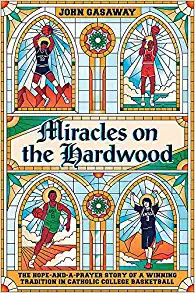
Review: Miracles on the Hardwood (2021)

By John Gasaway

College basketball fans probably have noticed something odd and interesting about their favorite sport. Catholic colleges and universities probably punch over their weight, as they say in boxing. In other words, they've had more great moments in basketball than in any other sport. 

Think about it. The list of Catholic schools with a long tradition is a long one. Consider such institutions as Villanova, Gonzaga, Georgetown, Loyola (Chicago), St. John's, Providence, Notre Dame, Marquette, Dayton, DePaul, Saint Joseph's and St. Bonaventure. They've all had some great moments in the sun.

If there's a common denominator there, it's that basketball is their best sport - the one that draws them national recognition. The outlier is Notre Dame. As for most of the others, they tried playing football at some point but realized they couldn't compete at the sport's highest level. But in basketball, you only need to recruit a few good players at a time. Against the odds, these schools have done this - some better than others, of course. But all have had some Glory Days over the years. 

Author John Gasaway decided to write something of a history of Catholic college basketball, entitled "Miracles on the Hardwood." Along the way, he's made an interesting discovery. The Catholic schools have about 12 percent of the nation's schools that play big-time basketball. They also have had 12 percent of the Final Four teams since 1939, and 12 percent of the national champions. 

I suppose you could argue that the success is something of a carryover to the founding of the nation's universities. Many of them started as small, private schools in the Northeast and Midwest. That tradition didn't carry over to much of the South and the West (say, west of the Mississippi River). So it's a two-tiered system in a sense, and it's kind of nice that the basketball tradition has carried over. Maybe the perfect moment for these schools came in 1985, when three of them - Georgetown, Villanova and St. John's - all made the Final Four from the Big East Conference.

Gasaway could have written a ponderous book with all sorts of religious angles and implications. Instead, he mostly sticks to basketball - and that was a great decision. This reads like a book of selected highlights in college basketball history - that just happened to involve players and teams from Catholic schools. What's more, the book is so well researched that any reader is sure to learn something about basketball and its history. And I do mean any reader.

For example, Bill Russell's college career comes across as something close to underrated - in spite of two national championships at San Francisco. He essentially revolutionized the game while playing the Dons, with his remarkable skills above the rim. Yes, Russell eventually became the greatest winner in NBA history (11 titles in 13 seasons), but his contributions become even greater when outlined here. There's a great story about how an official waved off a spectacular dunk by Russell ... because he had never seen such a player before, and he didn't think it could possibly be legal.

Then there's the case of the NIT and the NCAA tournament. Sometimes it is mentioned that the NIT was equal in stature to its big brother, but Gasaway shows how it happened. The Catholic schools of the 1950s felt more comfortable traveling to New York City for the NIT if they had a choice - fewer classes missed, etc. It was a tradition that continued through 1970, when Marquette opted out of an NCAA big because of a disagreement about seeding. It's easy to look back now and talk about the history of teams that won NCAA titles in the 1940s and 1950s, but the best teams didn't always compete in those events. 

Gasaway goes all the way back to players like George Mikan and Bob Cousy. He finds new stories about them and others, including personalities like Al McGuire. Heck, Loyola Marymount's moment in the sun even gets a chapter. The book also has some interesting if now forgotten anecdotes about the slow path of integration into the sport. The author not only has taught basketball analytics at Columbia (where were those classes when I was in college?), but he has a PhD from the University of Illinois. There are a few words that I needed to look up, so you'll feel smarter after reading this.

This is a book that feels like it has a rather narrow audience. Some younger readers might not care too much about the early days of college basketball. Along those same lines, the stories of the teams in the 2000s aren't quite as interesting - partly because there haven't been as many success stories, and partly because we're familiar with the rise of Villanova and Gonzaga.

Overall, though, "Miracles on the Hardwood" fits a niche nicely. It is better and more readable than I expected it to be - a delightful trip showing how - in part - we got to where we are today.

Four stars

Read more about this book from Amazon.com. (As an Amazon affiliate, I earn money from qualified purchases.)

Be notified of new posts on this site via Twitter @WDX2BB.