Sunday, August 27, 2023

Review: The 50 Greatest Players in Buffalo Bills History (2023)

By Robert W. Cohen

Sports fans have to do something between games. After all, teams don't play 365 days a year. So ... they make up lists. And argue.

If they need starting points, there are plenty of books out there to begin the discussion. Ask Robert W. Cohen. 

He's written a long list of books about "the 50 greatest players in (insert team here) history." They mostly cover the teams in major league baseball and the National Football League, but he does have one coming out on the Boston Celtics. Cohen now has gotten around to doing the Buffalo Bills. This one is called, naturally, "The 50 Greatest Players in Buffalo Bills History."

As you'd expect, Cohen has the format down pretty well. After a brief introduction, he starts with the early days of each player's life, and works his way through high school, college and the pros. The highlights are told along the way, including some quotes from the player himself or those around him. The author deserves some credit for not turning away from some unfortunate or tragic events that have surrounded some of the players. Obviously O.J. Simpson comes to mind in that category, although a few others like Jim Dunaway also could fit in there. The chapters end with Cohen picking a particular player's best season, follow by individual highlights. 

By coincidence, I had to pick my own best player in Bills' history for a discussion recently. I used my own way of coming up with the No. 1 choice. What player on the Bills could be considered for all-time list of the greatest performer in football history? In my opinion, Bruce Smith fits that description. Simpson might have been higher on that list had he played a few more years; that would keep him below players like Emmitt Smith and Walter Payton. But as you'd expect, both Smith and Simpson do really well here. 

I won't spoil the names and ranks here. Cohen went through the usual standards of rank on all-time team lists, games played, all-star/Pro Bowl selections, and so forth. It's always difficult to balance peak value in a season (think Josh Allen, at least for now) and career value (as in longevity as a high level). Let's just say I was surprised that Fred Jackson was ranked higher than Jack Kemp. 

I had a bigger problem with the career highlights. Many of them come up in the body of the story, and the others just aren't that interesting at this point in time. Yes, it fills out the book, but I found myself skipping over large sections of the individual chapters for that reason. That's a bit troubling, especially for a $28.95 list price.

Still, "The 50 Greatest Players in Buffalo Bills History" is a pleasant enough trip down memory land. If you like this sort of approach, it's professionally handled and will make you well prepared for any discussions that come up along these lines.

Three stars

Learn more about this book from Amazon.com. (As an Amazon affiliate, I earn money from qualified purchases.)    

Be notified of new posts on this site via X @WDX2BB.

Monday, August 21, 2023

Review: Nowhere Else You'd Rather Be (2023)

From The Buffalo News

Well, this is a little awkward.

The Buffalo News came out with a book on the 50-year history of the stadium in Orchard Park ... only days after my own book on the history of the Buffalo Bills was published. I don't think anyone expects me to say that the News' book is the only football publication you should buy this year. 

But on the other hand, The News was my employer for 23 years. And some friends of mine, including Corey Desiderio, Mark Gaughan and Jay Skurski contributed to the News' book. I would expect a worthwhile effort from these fine journalists, and they delivered one.

"Nowhere Else You'd Rather Be," adapted from the famous quote from Marv Levy ("Where would you rather be than right here, right now?"), sticks to the story of the stadium. That means the Bills will receive the lion's share of the pages, but not all of them. 

The story starts with the arrival of the Bills into War Memorial Stadium in 1960. A decade later, with the team snugly a member of the National Football League, it was obvious that the Rockpile had outlived its usefulness. A new building was needed if the Bills wanted to stay in Buffalo. The process was pretty ugly, particularly the conviction of some politicians on bribery charges. But Rich Stadium (The first suggested name was "Coffee Rich Park," by the way) eventually got built. It opened on August 1, 1973. 

The book sails through the various eras in Bills' history, highlighting some games along the way. I had to laugh when I saw that some of the quotes about those games turned up in both books. From there it's on to the owners, top players, records, and fans. Then the subject changes to football from other events that have taken place at the Abbott Road complex. This includes hockey, rock concerts, college football, and high school football. We wrap it up a short section on the new stadium. 

I had been told that this book would includes original stories from the events that took place in the stadium. We see reproductions of such text in the form of images of clippings and full pages of The News. But the text is generally original. 

The photos in the book come from The News' archives. This publication really does show how good the photographers at the facility have been over the years. Too bad we don't know who took each one, since most shots are uncredited. I did do a double take at a photo used to introduce a story on 2008's Winter Classic. The News allowed me to use that shot for the cover of a book I did on Buffalo's sports history in 2013.

"Nowhere Else You'd Rather Be" is something of a classic coffee-table book, with images you'll want to look at frequently. I suppose I can get away with saying that the text almost by definition has to be a bit more superficial than my book, considering the difference in the word count. But it's fair to say that the two books compliment each other nicely. You certainly could get away with buying and reading both of them. 

Learn more about this book from Amazon.com. (As an Amazon affiliate, I earn money from qualified purchases.)   

Be notified of new posts on this site on X @WDX2BB.

Wednesday, August 2, 2023

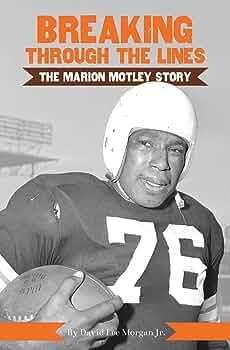
Review: Breaking Through the Lines (2023)

By David Lee Morgan Jr. 

It would be relatively accurate to say that Marion Motley was the Julius Erving of football.

Hear me out on this one. 

Both Motley and Erving did their best work when playing with "lesser" leagues. Motley first turned pro in the All-America Football Conference, while Erving's pro debut came in the American Basketball Association. By the time they arrived the more publicized National Football League and National Basketball Association, they probably were a bit past their prime - although Erving's decline was slower. But that doesn't change the fact that both were fabulous at their peak. 

Motley is the lesser-known figure to today's audiences, since he played in the 1940s. Therefore, it's always good to see new material on his football career. David Lee Morgan Jr. obliges with his biography of the standout, "Breaking Through the Lines."

Motley is an important figure in football history, as he helped reintegrate the sport. A few Blacks had participated in pro football in the 1920s and early 1930s, but a line was drawn in 1933 by the NFL. The sports was lily-white until 1946. That's when Motley and teammate Bill Willis both arrived on the roster of the AAFC's Cleveland Browns. They didn't just break the color line, they smashed it. (Two other African Americans played for the NFL's Los Angeles Rams that year.)

Since Motley played for the less established league during the 1940s, his exploits were generally missed. There was no television coverage, and fewer big crowds. But Motley was a fullback who resembled a tank on cleats. He was simply too big and strong for most defenders. If there was a piece of territory on the football field that was unclaimed, Motley usually knocked over an opponent to claim it. A couple of tight ends in the 1960s, Mike Ditka and John Mackey, had that same reputation as receivers. Motley also could play defense, where his size and speed also served him well. So he was too strong to tackle, and too strong to block. That sounds like a successful football player. 

Morgan outlines his career well enough. Motley moved from the South to Ohio as part of the Great Migration, and played college football. Eventually he encountered Paul Brown, who coached the original Browns and made the decision to keep Motley on the roster. 

The future Hall of Famer's career ended with something of a whimper. He developed knee troubles soon after the NFL-AAFC merger in 1950. Marion hung on as long as he could, but eventually had to retire a little prematurely. The transition to life after football was difficult for the Black players of that era. Doors to coaching jobs usually were locked, and in those days no ex-player could live off his sports reputation. 

This has the makings of a good biography, since the idea is to bring a legend back to life. But Morgan comes up short in presenting new material here. The pages - less than 200 - go by really quickly in a rather superficial telling of the story. That's particularly true of Motley's days in the AAFC, which could have been expanded rather easily. 

Morgan had previously worked on a PBS documentary on Motley. The writer comes across as very fond of his subject in the book, and not without good reason. It's easy to root for the pioneers in this area. But this approach leaves the reader wondering if there's any more to the story. 

"Breaking Through the Lines" does provide the basics on an important figure in pro football history. Still, I would guess that many will come away from this wanting more. 

Three stars

Learn more about this book from Amazon.com. (As an Amazon affiliate, I earn money from qualified purchases.)   

Be notified of new posts on this site via Twitter @WDX2BB.

Wednesday, July 26, 2023

Review: The Occasionally Accurate Annals of Football (2023)

By Dan Patrick and Joel H. Cohen

Dan Patrick and Joel H. Cohen gave themselves a tough assignment: write a funny book about football history. 

There are, to use the obvious analogy, some big holes to run through when it comes to comedy targets in the NFL. Picking on the New York Jets and Detroit Lions in regard to their history is, to use the obvious analogy, "low-hanging fruit" as these things go. Even so, that leaves the rest of the book. Let's face it - sports comedy is usually hard work, and frequently hard to pull off.

So start the fact that Patrick and Cohen get points for trying. The resulting effort is called "The Occasionally Accurate Annals of Football." That may sound a way to clean up some popular misconceptions about pro football. But instead it's more of a launching point for jokes. 

The two authors know something about the two parts of the task. Patrick virtually invented a different type of sportscasting when he and Keith Olbermann worked together on "The Big Show" some years ago. They were smart and hip and quick and snarky and, of course, funny/funny/funny. Cohen writes for the television show, "The Simpsons." It's been argued that Homer, Marge, Bart and Co. are the stars in one of the best-written comedy shows in television history. We're in pretty good hands here. 

Patrick and Cohen also call on about eight other writers to supply material. Most of them are writers for shows like "The Simpsons" and "Saturday Night Live." It's always a good idea to have a deep roster when football comes up. Oh, and Adam Sandler writes the introduction. 

With that out of the way, we're off on a journey through football history. They start with the origins of the game, and eventually work their way through the rise of college football in the late 1800s until the birth of the pro game, more or less with the start of the NFL in 1920. From there, we take a decade-by-decade look at the sport in the past century, never missing a chance to go off on a tangent or crack a joke. 

Just to take a few a random:

* The Cardinals play their games in State Farm Stadium, which has the catchy State Farm slogan, "Like a good neighbor, we'll charge you thirty dollars to park."

 * (Mike) Ditka was frequently referenced in the Saturday Night Live sketch that popularized the expression "Dah Bears." Incidentally, "Dah Bears" is also the answer to "Who Ate Dah Campers?"

* The Bills are famous for appearing in four straight Super Bowls (1991 to 1994) and losing them all. Bills management, feeling bad, gave all of the players "Participant" rings, which now sit lonely in their barren trophy cases.

* (On Josh Allen) "He's the future of the Bills, football, and maybe the world." (This sentence provided by the Bills PR department and approved by the Campaign to Elect Josh Allen President.)

Got the idea? Great.

Your reaction to all of this depends on your sense of humor and your knowledge of football. You will laugh out loud at times, you'll give it a chuckle at times, and you'll smile a little at times. But should you pay $29.95 for it? That's a tough question. That's a good-sized pile of change for a book that you can zip through in a day. I enjoyed breezing through it, but can't say I remember too much about it a day later. 

So you might want to take this for a test drive. Next time you are in a bookstore, check to see if it has a copy (release date is September 5). Then flip through the pages in an attempt to get a feeling about the material. If you like the approach, great - the laughs are almost guaranteed. If not, don't worry. Comedy is rather personal. I didn't have a particularly strong reaction, so you're on your own. 

Three stars

Learn more about this book from Amazon.com. (As an Amazon affiliate, I earn money from qualified purchases.)   

Be notified of new posts on this site via Twitter @WDX2BB.

Friday, July 21, 2023

Review: The Big Time (2023)

By Michael MacCambridge

Attention must be paid, as the saying goes, when Michael MacCambridge has a new book out. 

The veteran author and editor has a good-sized string of success stories to his credit over the years. He's written "America's Game," "Chuck Noll" and - one of my personal favorites - "The Franchise," a history of Sports Illustrated magazine.

Now MacCambridge takes on a bigger subject: sports in the '70s. "The Big Time" is thorough, well done and interesting ... as usual.

Take it from someone who was there, the Seventies were a time that shaped the modern world of sports. After a couple of generations in which sports were a connected series of mom-and-pop operations, a pair of developments changed everything. 

The first involves the relationship between the players and their bosses. That covers a variety of areas, but two in particular come to mind. The first is the legal ground rules for leagues in the form of collective bargaining. Through a variety of ways, the players started to have more of a say in determining their professional future. Free agency arrived in baseball in 1976, and that led to an explosion of interest and money for all concerned - as opposed to the gloom and doom predicted by owners at the time. The other major sports eventually followed along, usually after some painful moments in the courts. The days of "you'll play where we tell you to play, and you'll take the money we want you to have" were over for good.

Part two of that concept involves African Americans. Keep in mind that even in the late 1960s, the national championship team in college football did not have a Black player on its roster. There were a few Black players who had started at quarterback or middle linebacker - supposedly the most cerebral positions on the roster. There were no African American head coaches or managers. Muhammad Ali started the decade as something of an outcast; he finished it as an American hero. The list goes on from there, but you get the idea. Progress was slow, and it's still too slow in many ways, but at least change had begun.

The other development involved women. In some cases, women weren't allowed to participate at all in certain athletics. It was believed that it wasn't feminine, and/or that strenuous physical activity would somehow damage some delicate body parts. When they did get to play some sports, they were decidedly second-class citizens. In tennis, for example, the prize-money distribution was terribly imbalanced. 

Title IX changed all of that, of course. Suddenly, universities had to achieve something close to parity in athletic opportunities by gender. Billie Jean King led that fight in many ways, and not just in tennis. You can still hear the screaming by administrators from that era, and it gets more tone-deaf as the days go by. The funny part is that once women started playing sports, they started watching sports of all types as well ... increasing the fan base, and thus raising revenues, in the process. The administrators didn't mind that part. 

There is a lot of ground to be covered here, and MacCambridge can't spend too much time in terms of pages hitting all of it. So the book is something of a survey of the landscape in the decade. The big events are covered - the King-Riggs tennis match, the Seitz decision on baseball free agency, Monday Night Football, the rise and fall of some new leagues, etc. MacCambridge covers them well enough to get the points across. The author also has found plenty of interesting little moments and facts to drop into the conversation that are quite fresh today and add some perspective to the discussion. 

I found the story of the AIAW to be particularly interesting, as it has been undercovered over the years. That was the group that banded together to start competitions to determine champions in certain women's sports, most notably basketball. It wasn't easy. Eventually, the idea was swallowed up by the NCAA - which probably was inevitable. It wasn't the idealist result that the AIAW hoped to achieve, but it was progress. 

Some of the material here will be familiar to those who lived through it or who have read about those key moments. Others on the young side may be a difficult sell. But those in the sweet spot of the group that wants to learn about the turning points in the story of "How did we get here?" (thank you, David Byrne), "The Big Time" will work just fine.

Four stars

Learn more about this book from Amazon.com. (As an Amazon affiliate, I earn money from qualified purchases.)   

Be notified of new posts via Twitter @WDX2BB.